How long does a payment to India actually take?
Why UK-to-India business payments take one to five business days, what actually causes the delays, and how to pick a route that lands faster.
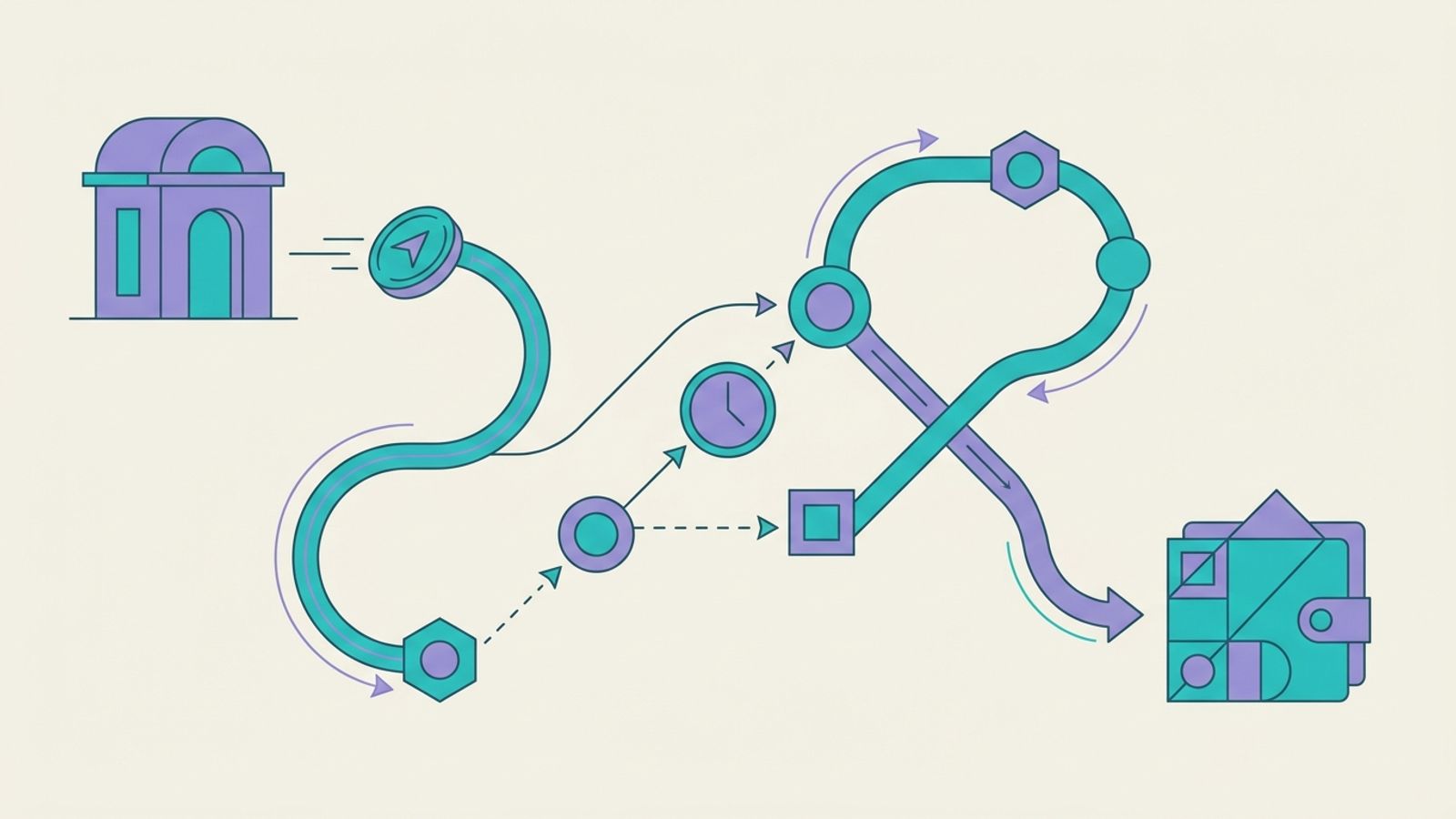
Your finance team sent the wire to your Indian design studio on Monday morning. By Thursday their invoice still shows unpaid, and the studio's founder has messaged twice asking if something went wrong on your end. Nothing went wrong – the payment is probably sitting inside a correspondent bank's queue, or waiting for the next business day in Mumbai. But “probably” is not a great answer to give a vendor you want to keep working with, so it's worth knowing what actually decides how long a payment to India takes, and what you can do about the parts you control.
What actually determines the timeline
A payment from a UK business account to an Indian bank account rarely moves in a straight line. Unless your provider has a direct settlement rail into India, your money passes through one or more correspondent banks – intermediaries that both your bank and the receiving Indian bank trust, because they don't have a direct relationship with each other. Each hop adds a processing window, and each bank runs its own compliance and sanctions screening before passing the payment on.
On top of that, foreign exchange settlement only happens within market hours, and Indian banks work to Indian business days. Send a payment from London at 4pm on a Friday and it may not even start moving in India until Tuesday, once the weekend and any bank holiday on either side are accounted for. A payment initiated an hour before a cut-off can sit overnight for no reason more complicated than timing – the bank simply didn't have the window left to process it that day.
None of this is unique to India, but India-bound payments tend to pass through more intermediary banks than a payment to, say, another EU country, so there are simply more places along the route for a hold to happen. That's the gap between “the transfer is instant” marketing language and what actually lands in your vendor's account.
Typical timelines, corridor by corridor
For a standard UK-to-India business wire, one to two business days is the best case: a well-established provider, an existing beneficiary, and a payment sent early in the week. Three to five business days is closer to typical once a payment routes through more than one correspondent bank, and delays beyond that usually mean the payment has been held for manual review somewhere in the chain, not that it is simply “slow” (Skydo, Remitbee).
What the transfer platforms actually promise
Every provider quotes a delivery window, but the fee attached to it varies more than most UK finance teams expect. Using the same pricing data as our own calculator, checked this month, here's what four widely used platforms publish for a UK business sending USD-denominated payments through to India:
| Provider (plan) | Fee, as published | Typical delivery | Source, as checked |
|---|---|---|---|
| Wise (Business) | $7.08 fixed + 0.4182% FX (USD→INR) | 1–2 business days | wise.com, checked 19 Sep 2026 |
| Revolut (Basic) | £5 transfer fee + 0.6% FX above £1,000/month | 1–2 business days | revolut.com/business |
| Airwallex (Business) | $25 fixed + 1% FX (SWIFT) | 1–2 business days | airwallex.com pricing |
| Payoneer (Business) | From 1.2% FX, $20 minimum (lower-bound estimate) | 1–3 business days | payoneer.com pricing |
On a $10,000 payment, that fee structure works out to roughly $48.90 with Wise, $58.66 with Revolut, $120 with Payoneer and $125 with Airwallex – all before you account for how much of the “mid-market rate” claim on the invoice actually survives to the FX rate you're quoted. None of these figures are Winvesta's; they're what each provider states for its own plan, and worth rechecking directly before you commit to a route, since providers revise pricing without much notice.
Where payments actually get stuck
The single biggest cause of an unexpectedly slow payment isn't the wire network – it's a hold at a correspondent bank. These banks run their own anti-money-laundering and sanctions checks independently of your sending bank, and a hold can trigger without any alert reaching you or your recipient until the funds clear it. Common triggers include a new beneficiary the correspondent bank hasn't seen before, a payment that's unusually large relative to your normal pattern, incomplete or slightly mismatched beneficiary details, or a corridor the bank treats as higher-risk (Instarem, Statrys). None of that is specific to India – the same checks run on payments into most countries – but India-bound payments tend to pass through more intermediary banks than, say, a payment to another EU country, which is exactly why they have more places to get held.
A rule aimed at exactly this problem
The Reserve Bank of India issued guidelines on 9 April 2026 requiring Indian banks to credit inward cross-border payments on the same business day they're received, provided the payment lands within foreign exchange market hours; anything received after hours must be credited the next business day. Banks also have to notify the customer as soon as the inward payment message arrives, and reconcile their nostro accounts at least once an hour rather than once a day. The rule takes effect six months after issue – around 9 October 2026.
It's a real fix for a real problem, but it only closes one part of the journey. The RBI's rule binds Indian banks once money has already reached them; it says nothing about the correspondent-bank hops or compliance holds that happen before that point, which is where most of the multi-day delays described above actually occur. Treat it as removing one source of lag from the last leg, not as a promise that every payment will now land same-day.
How to actually pay faster
A few things are within your control regardless of which rule is in force:
- Send early in the week and early in the day. A payment initiated Monday or Tuesday morning has more working days ahead of it to absorb a hold than one sent Friday afternoon.
- Get the beneficiary details exactly right. Account number, account holder name and IFSC code need to match what the recipient's bank has on file – small mismatches are one of the most common causes of a manual review.
- Ask what rail the provider actually uses for India. A provider settling through its own local partnership tends to skip correspondent-bank hops entirely; one routing everything over SWIFT does not.
- Keep documentation ready for a new or large beneficiary. An invoice or contract that explains the payment can shorten a compliance review if one is triggered.
None of this guarantees a specific delivery time – no provider's marketing claim does either – but it removes the delays that are actually within a payer's control. It's also worth keeping your vendor informed once a payment is sent: a short note with the date it was sent and roughly when it should land does more for the relationship than a status update after they've already chased you for one.
Winvesta pays Indian vendors, contractors and teams directly, without charging your business a sender fee or applying an FX markup on top of the mid-market rate. It won't make a correspondent-bank hold disappear, and it isn't a UK bank account or a source of tax advice – it's one wire from you that Winvesta splits across as many Indian recipients as you need, each one KYC'd once. If slow, unpredictable payment timing to India is costing you vendor goodwill, see what a faster route looks like.
Frequently asked questions
How long does a payment from the UK to India usually take?
Most business payments land in one to two business days in the best case, and three to five business days is common once a payment routes through more than one correspondent bank. Longer than that usually means the payment has been held for manual review somewhere in the chain.
Why is my SWIFT payment to India stuck with no update?
It's most likely sitting at a correspondent bank's compliance or sanctions-screening step. These holds can happen without an alert reaching either you or your recipient, so the payment can look “stuck” even though it's moving through a normal review.
Does the amount I'm sending affect how long it takes?
It can. A payment that's unusually large relative to your normal pattern, or sent to a beneficiary a correspondent bank hasn't seen before, is more likely to trigger a manual compliance review than a routine, expected payment.
Will the new RBI rule mean payments to India now land the same day?
Not automatically. The rule, effective around 9 October 2026, requires Indian banks to credit a payment the same business day once it has actually reached them. It doesn't change how long the payment takes to get to that bank in the first place, so correspondent-bank delays before that point are unaffected.
Is a bank wire or a fintech transfer provider faster for paying India?
It depends more on whether the provider has a direct settlement rail into India than on whether it's a bank or a fintech. A provider settling locally in India tends to skip the correspondent-bank hops that cause most delays; one routing everything over SWIFT does not, regardless of how it's branded.